REVEALED: HOW ABACHA’S STRONG MAN,AL MUSTAPHA, WANTED TO REVENGE HIS DEATH ON NNANNA UKEGBU


In the recently published biography of late elder statesman, Dr Basil Nnanna Ukegbu, an expose was made of what appeared to be an attempt by Major Hamza Al-Mustapha, who was the Chief Security officer to the late head of state, General Sani Abacha, to avenge the latter’s death on the late politician.
In chapter 19 of the book titled, “… The Purpose Of My Life”: Amazing Story of Dr. Basil Nnanna Ukegbu,” veteran journalist and award-wining author, Ethelbert Okere aka E.T. Okere, gave an account of Ukegbu’s narrow escape from an arrest by Major Mustapha who stormed his home in Amafor, Imerienwe, Imo state, in the tick of the night.
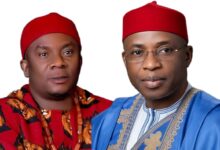
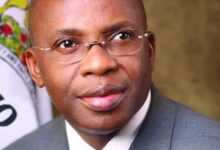
In the Chapter 19 titled “Ukegbu And The Military Juntas”, the author gave the background to that sordid episode: “Ukegbu’s general discomfiture with the emergence of another military regime in 1983 prompted him to retreat from the political and social space. Although he had gotten the nod to continue with his two secondary schools, running them did not constitute enough challenges for a man who, at the age of 27, had founded a grammar school that became one of the best known in the entire Eastern Nigeria. A man who was born to always think big, Ukegbu still had his eyes on something bigger. So, he handed over the running of TEDEM College and Dorothy College to his wife and spent most of his time in writing and strategic planning throughout the duration of the Buhari military administration. However, following the overthrow of Buhari by Ibrahim Babangida, Ukegbu felt that there might have emerged a new vista for the social, economic and political resuscitation of Nigeria.
Thus, not long after Babangida came to power, he wrote proposals which he forwarded to the new head of state especially on how to transform the rural communities as well as on the social and economic mobilization of the rural masses of the people. One of such papers led to the idea of Peoples Bank and which he fashioned after his Ngor Okpala Experiment as earlier narrated. The idea was, however, hijacked but even though no credit was given to him as the originator, Peoples Bank was created and handed over to those who, not being part of its creation, had no idea of what to do with it. Hence, the bank died naturally not long after it took off.
Shortly after, Babangida came up with his two-party concept and Ukegbu, in keeping with his belief in a two mega party structure, keyed into it by joining the National Republican Convention (NRC). He later decided to participate in an experimental template wherein every state was to produce a presidential candidate that will be part of an electoral college to produce a national presidential candidate for each of the parties. He lost to Chief Greg Mbadiwe at the mini state presidential convention. At the national level, Alhaji Bashir Tofa emerged as the party’s (NRC) presidential candidate with Dr. Sylvester Ugoh, an indigene of Imo sate, as running mate.
Once again, Ukegbu returned to his cocoon to re-strategize. He remained largely inactive for the remainder of the Babangida regime but was forced out again by the sordid events following the emergence of the regime of General Sani Abacha. Ukegbu felt that Nigeria was slipping into a fascist state and that there was the need for leaders like him to do something. So, he began to mobilize top Nigerian political leaders. Initially, they held secret meetings but at a point, the group came out openly and issued a public statement on the state of affairs in the country. That group soon metamorphosed into the G34 led by Dr. Alex Ekwueme.
While details of G34’s engagement with the Abacha regime were being worked out, Dr. Ukegbu began to protest publicly. He began to carry placards on the streets of Owerri. His activities culminated in a drama that saw him sleep in an open space at the famous AMA J.K area in the Owerri municipal. For several days, he refused all entreaties by friends and relatives to leave the place and return to his house for his safety.
1E T Okere

When he finally accepted to leave AMA J.K, Ukegbu continued with going round parts of the Owerri Municipal distributing handbills containing messages that were very critical of General Abacha and his regime. He was eventually arrested by men of the State Security Services (SSS), now known as Department of State Service (DSS), on the orders of the then military Administrator of the state, Colonel Tanko Zubairu. After his arrest, two of his sons went to see a top traditional ruler in the state, said to be a close friend of the military administrator, to intervene and secure their father’s release. The traditional ruler told the sons to write a statement to plead that their father was insane. They refused and Dr. Ukegbu was charged to court but released on bail.
But contrary to the expectation that he would be sobered by his arrest, detention and arraignment, Ukegbu became even more vitriolic in his attacks on Abacha and his regime. He issued press statements which the pro-democracy Lagos-based newspapers were only very glad to carry with banner healines. In one of the statements, he rhetorically posed the following question: “Supposing That Abacha Dies Today, Will Nigeria Cease To Exist?”. Incidentally, General Abacha died just a day after the statement was published; reminiscent of what happened on the floor of the federal parliament on January 12, 1966 and the military coup, three days later, on January 15, 1966, as earlier narrated in chapter Nine.
General Abudulsalami Abubarkar, who was Chief of Army Staff under Abacha, mounted the saddle. One of the first things the new head of state did was to post Abacha’s Chief Security Officer, Major Hamza Al-Mustapha, to the 82 Division of the Nigerian Army in Enugu. Barely a week after his arrival at Enugu, Major Mustapha traveled all the way from Enugu to Amafor, Imerienwe, with a group of soldiers probably to kill Ukegbu since there couldn’t have been any legal grounds for his arrest and prosecution. Apparently, Mustapha, who was highly powerful and influential during the regime of his late boss, and was, in fact, seen in several quarters as the defacto head of state, was not satisfied with the way Ukegbu’s matter was earlier handled, especially against the backdrop of his ‘prophecy’ over Abacha’s death. However, Mustapha did not succeed in getting at Ukegbu who was shepherded to safety by one of his sons, Anthony, and wearing just a wrapper and a shirt. He was led through the bush to Umunakara, an adjoining village, also in Imerienwe, from where he escaped to Port Harcourt.
After searching the house and Ukegbu was nowhere to be found, Mustapha arrested a lady and one of the daughters of his elder brother, Godson. The two were taken to the headquarters of the Imo State command of the Nigerian Police Force and handed over to the latter. A few days later, the lady and Ukegbu’s niece were released without any charges. Ukegbu remained in hiding outside his home in Amafor, Imerienwe until the General Abdulsalami’s – he was more popularly known with his first name – regime stabilized. Even after he came out from hiding, he remained almost incommunicado until Abdulsalami announced the lifting of the ban on political activities”.
Twenty six years after that saga, close relatives of Dr. Ukegbu and all those who knew about it are still wondering on what was actually Al -Mustapha’s motive of storming Ukegbu’s house at such an odd hour. They believe that there could have been no reason other than to avenge Abacha’s death since, as seen in the passage above, there was no plausible reason to arrest and prosecute him. True or false this recent revelation which many Nigerians were unaware of before now, perhaps adds an entirely new segment to the nation’s chequred political history.