By Ethelbert Okere

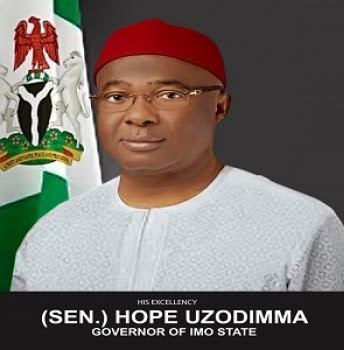
Governor Hope Uzodimma has never been under any illusion that the path to the realization of his Shared Prosperity vision for Imo state would be lined with roses. He knew right from the beginning that the opportunity cost of pursuing a wholistic transformation of the state would be quite high, especially in terms of keeping his personal relationship with some of his friends who saw his emergence as governor as a life time opportunity to achieve their personal goals.
As expected, therefore, he is getting the heat for the tenacious pursuit of his vision but the real tragedy for the entire state will be if he capitulates. Perhaps to assist the governor to remain steadfast in his resolve, it is pertinent to remind him of what he told the good people of Imo state on the day he took oath of office on January 15, 2020: “I will execute with utmost diligence and fidelity the five cardinal programmes of my administration anchored on Reconstruction, Rehabilitation and Recovery to ensure prosperity for all”. Governor Uzodimma had gone further to explain his “Prosperity For All” mantra when, in his maiden broadcast to the people on January 18, 2020, he said: “Our new Imo will enshrine a new Shared Prosperity in which the common wealth of the people is made available for the good of all”.
Now, almost five years after making those pronouncements, it would not be out of place to ask the question: How far? How far has Governor Uzodimma gone in pursuit of his “Shared Prosperity” objective? The answer to this question would depend on who is asking. If the question is coming from those friend of his who, as earlier noted, saw his ascendency as a golden opportunity, the answer would certainly not be positive.
Of course, this group is made up of those who chose to look only at the “shared” aspect of the mantra and gave it an extremely simplistic meaning; which is that the governor meant that he would be sharing money in its literary sense. Fortunately, they are in an infinitesmal minority; which means that for a far great majority, Governor Uzodimma’s Shared Prosperity Vision is very much on course, albeit the debilitating harsh economic climate that currently envelops the entire country.
The sincere answer to the question would,therefore, be that Governor Uzodimma might not have turned every household in Imo state into a paradise but there can be no doubt that he is laying a solid foundation to set the stage for a take off into sustainable economic development and social prosperity for the entire Imo collective. What further goes for the governor is that he is dealing with a populace that has the gift of being able to look at the bigger picture and are, therefore, prepared to remain steadfast in their expectations of a greater Imo; the basis of this big expectation being that they are witnesses to the governor’s capacity to deliver, even if there might be some challenge in the process.
In other words, as against the attitude of the miserable minority that, for example, accuse the governor of failing in turning his appointees and friends into millionaires – and in just four years for that matter – Imolites, generally, do not allow themselves to be stampeded into despondency. Of course, that is what is expected of a people rated as among the most sophisticated and discerning in the entire nation.
Thus, contrary to the narrow definition of Shared Prosperity – to mean sharing money among a few of his so-called friends-Imolites, generally, knew that the road to economic prosperity, however it is qualified, is a long one and that it requires resilience and a transcendental approach that gives little room for tentative praise singing which vanishes immediately the fribbies are consumed.
In the last close to five years, the trajectory of the Uzodimma administration has been to pursue programmes that would lift a vast majority of the Imo populace out of poverty, through the following vehicles: provision of good health facilities, provision of qualitative education, provision of portable water and a clean environment, revival of infrastructure, especially road infrastructure , gender equality, higher skill acquisition, increased agricultural output etc etc. In its first four years, the administration achieved quite a lot in each of these areas details of which are too well known to be tabulated in a short essay this nature. But what nobody can fail to mention is that the governor went further to target a stronger and wider macro-economic framework within which to pursue his transformation agenda.
Those who should know point at the fiscal policies of the administration in the last five years; policies which are deliberately tilted towards boasting expenditures that will put the wellbeing of the people at the centre of governance. In the last three fiscal years, the administration has steadily increased its budgetary provision for capital expenditure, which it increased from N284.4 Billion in 2022 to 377,56 Billion in 2023 out of a total Budget of N474.46 Billion and which it christened “Budget of Wealth Expansion”. In the current 2024 budget, Governor Uzodimma demonstrated even a greater determination to stimulate and fast track the growth of the state’s economy by devoting a whopping 82.9 per cent of the total budget to capital expenditure. Of a total of N582.2 billion naira budget, 491.2 billion naira is for capital expenditure. Apart from that it represents the highest allocation to capital expenditure in the budgetary history of the state, this very ambitious capital out lay for fiscal 2024 is part of a ten-year development plan which focuses on the proposed Orashi Free Trade Zone together with the Orashi Electricity project, youths empowerment, agriculture etc ;as a strategic imperative for massive economic growth within the period under focus.
But while keeping this medium to-long-term plan in a robust view, Governor Uzodimma was the first governor to take advantage of the new constitutional provision that removed Power generation and transmission from the Exclusive Legislative list to the Concurrent; to establish the Imo State Electricity Regulatory Commission (ISERC) and in accordance with the new law that now empowers states to establish and regulate their own intrastate electricity ecosystem. In August 2024, the state government signed a Memorandum of Understanding (MOU) with the Orashi Electricity Company Limited to generate, transmit and distribute electricity in all the 27 local government areas of the state. At the occasion of the signing of the agreement, on August 27 2024, Governor Uzodimma said it “marks the commencement of all the plans put in place to light up Imo state and ensure that electricity gets to the 27 local government areas of the state on a permanent and steady basis”. The governor went further to say that “government sees the project as a critical priority project that must be accomplished within records time”. Governor Uzodimma also reiterated that the state needs power to revitalize ailing industries, bring in new ones, create jobs and improve on the ease of doing, business in the state adding that “by so doing the people will be empowered, life made more meaningful and our people will live longer”.
It needs no exaggeration to state that this singular move to find a lasting solution to the problem of power in Imo state is the beginning of the march towards a total transformation of the state economically and socially. Once power supply is guaranteed, the stage is set for the private sector to take off; so that an economy, in the real sense of it, can be created for the state, a situation that will be dully complemented by the industrious nature of the good people of Imo state. In the quest for the realization of this objective, perhaps the most critical factor is the governor’s determination to sustain the people’s buy-in to the end. And this is why it is incumbent upon every well-meaning indigene of the state to ensure that no credence is lent
to any tendency that may jeopardize the people’s enthusiasm towards the collective quest for the realization of the noble objective of this all important power project. Agreed, no system is error proof but the people must ensure that some privileged members of the society do not succeed in scuttling their collective dream in pursuit of self-serving interests.
Fortunately for the selfless majority, there are things to point to as testaments of Governor Uzodimma’s ability to deliver: An unprecedented infrastructure revolution especially on road, an uplifting of the state’s education sector to a level never known before. For the first time in its history, the state now has three state-owned universities – the Imo State University, which had been in existence before Uzodimma came to office, the University of Agricultural And Environmental Sciences, which he established upon assumption of office and the Kingsley Ozumba Mbadiwe University which he recovered from one of his predecessor on behalf of the state. These are in addition to a polytechnic at Omuma and a College of Education in Ihitte Uboma.
Imolites should also be encouraged by the fact that outsiders, both individuals and organizations, that have no vested political interests in the state have scored the Uzodimma administration quite high in its performance in sundry areas. A couple of months ago, FATE Foundation, one of the world’s most prestigious and highly reputed organizations in human development analysis, ranked Imo state as number one in Nigeria in entrepreneurship and literacy indices. Another data analysis company, Statissence, after a survey it conducted in collaboration with the Federal Ministry of Education, scored Imo state very high on investment in the education sector. In the study that was conducted within the last
three years, Imo state ranked 36th on the table of out-of-school children in the country with 5.1 per cent. The state also ranks first on the table of states with most students admitted into Nigerian universities for some of the most critical fields like Medicine, Law, Mass Communication and Computer Science.
Imo was also listed as topping other states in the former Eastern region in Women Literacy, having polled 83.5 per cent of the total number of states sampled to emerge in the first position in Literacy rate among women aged between 15 and 24 years. While releasing the result of the survey, the agency drew attention to its significance; in the context that since it is the age during which young women go through secondary and tertiary education, it means that the state government, under Uzodimma, is proactive in preparing its young women for future leadership roles.
The same survey also scored Imo state very high in the area of health care. The result of the survey showed that the state leads both the Southeast and Southsouth geo-political zones in the provision of functional health facilities. Currently, Imo state operates 1,335 health facilities across its twenty seven local government areas. With that,Imo comes fourth among the thirty six states of the federation plus the federal capital territory; only behind Lagos, Kaduna and Ogun states: While Lagos is leading with 2,171 health centers, Kaduna and Ogun states respectively have 1,556 and 1,380 and Imo 1,335. Even so, the survey shows that in both the Southeast and Southsouth, only Imo operates more than 1,000 health facilities. These performances were not for nothing. They were the outcome of Governor Uzodimma’s deliberate efforts to develop the state’s health sector by injecting creative and innovative ideas. For instance, the governor in 2022 created a Ministry of Health Insurance separate from the main Ministry of Health.
This landmark innovation made it possible for the smooth take off of the provision of free and comprehensive health care to over 84,000 vulnerable Imo residents across the 305 electoral wards through the Basic Health Care Provision Fund (BHCPF). The Ministry of Health Insurance staff undertakes periodic monitoring and evaluation of Primary Health Centers in the state in order to have an on-the spot- assessment of compliance and implementation of the programme.
Nobody can, of course, say that Imo state has been turned into an Eldorao in the last five years under Senator Hope Uzodimma’s watch, what with the debilitating economic condition in the country as a whole. The lamentations are genuine but there certainly is a silver lining in the horizon. The good people of Imo state should be encouraged by the bold vision that is taking shape, the transformation of their state into a power house of industrial innovation and sustainable development.