IT’S NOT JUST INFRASTRUCTURE: GOVERNOR UZODIMMA IS GBURUGBURU (THE ALL ROUNDER)

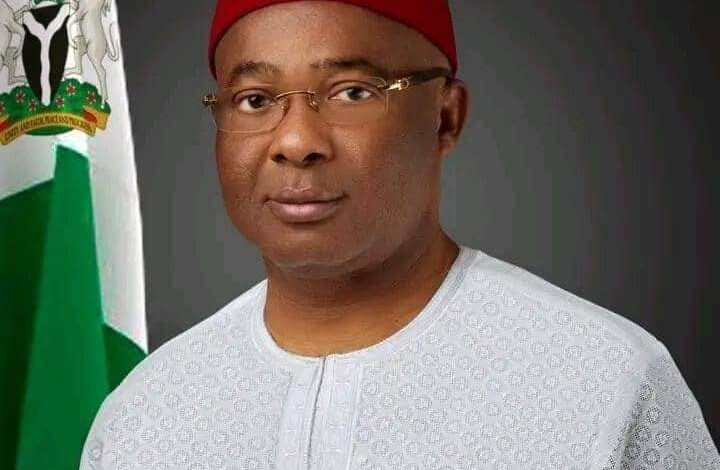
IT’S NOT JUST INFRASTRUCTURE: GOVERNOR UZODIMMA IS GBURUGBURU (THE ALL ROUNDER)
By Ethelbert Okere
As a critical stakeholder in the Shared Prosperity administration of Governor Hope Uzodimma, I am q`uite appreciative of the gestures by the highly influential Vanguard newspapers, perhaps the oldest daily in Nigeria today, in conferring the Infrastructure Governor of The Year award to the people’s governor, Senator Hope Uzodimma. His Excellency had earlier in 2022 received the Governor of The Year award from the Sun newspapers which was no less a feat but the Vanguard award, in more ways than one, is perhaps more significant; in the sense that it enables observers to appraise the governor after he had completed his first term. In other words, much as the Infrastructure Governor Of The Year is a great thing – since it is indeed the area the governor has excelled – the occasion offers an opportunity to take a more transcendental view of the Uzodimma administration, that is, beyond infrastructure.
By the end of such an appraisal, nobody will be left in doubt that His Excellency, Senator Hope Uzodimma, is, indeed, what in my native parlance we describe as Gburugburu (All Rounder). Much as physical infrastructure is highly important for development, observers have since pointed out that where Governor Uzodimma really sets himself aside is in the intangible, where he has been scored over 80 per cent. When this is juxtaposed with the fact that good governance, according to governance experts, is over 70 per cent on intangible, it becomes trite to argue that Governor Uzodimma is among the best in the present class of governors.
Before we elaborate more on that aspect, let us return to the tangible – the area he has been rated so highly to the extent that a newspaper of Vanguards rating deemed it fit to stamp its imprimatur on. By the time Governor Uzodimma resumed office in January 2020, there was a total breakdown in critical infrastructure in Imo state. There were hardly any road in the state that was motorable. Even though his immediate predecessor, Rt. Hon. Emeka Ihedioha, had set out to tackle the problem of roads, his seven months stint was too short to enable him make an impact.
Ihedioha’s predecessor, Rochas Okorocha, had this fantasy of opening roads left, right and center but they were of very poor quality; so that by the time he left office, Imo state was inundated with roads in quantity but lacking in quality. Okorocha must have meant well, but he – perhaps unintentionally – left behind more roads in disrepair than he met. That was the situation when Uzodimma arrived and gingerly took stock.
Fortunately, Uzodimma as a governorship candidate had earlier chosen his three dimensional (3R) mantra of Reconstruction, Rehabilitation and Recovery; and not unexpectedly, he started from the first two. What struck him was to reintegrate the various parts of the state which had been physically – and even politically – alienated from each other for sundry reasons. Hence, he immediately embarked on the reconstruction and rehabilitation of the roads that linked the seat of government, which is situated in one of the three senatorial zones, with the other two; talking about the Owerri-Orlu road and the Owerri-Okigwe road.
The reconstruction and rehabilitation of these two roads marked the beginning of a new era in Imo state. For the first time, the people saw that it is no rocket science taking away the nightmare pose by the 34-kilometer Owerri-Orlu road. Imolites discovered that no magic was done to reduce the close to two hours it took to travel through a mere 34-kilometer distance to just about twenty five minutes. Ditto for the 53-kilometer road from Owerri to Okigwe which hitherto took commuters upwards of three hours but reduced to juts about thirty minutes.
Interestingly of the three hours, two hours were spent at just one spot known as Ekemele somewhere in Ikeduru local government area. As a matter of fact, it came to a point when tales of a certain deity dwelling at that spot as the reason it defied all previous efforts to repair the less than a quarter of a kilometer stretch. But Uzodimma came and demonstrated that it was just a matter engineering science. Once done with the two roads, he headed for the Owerri-Emekuku-Mbaise-Obowo road leading to the border between Imo and Abia states along that Owerri-Umuahia axis.
Curiously, his opponents criticized him for doing “federal roads” instead of those linking towns and villages; but that was merely one of the political jibes by those that had just been dispossessed of power. That posturing by the so-called opposition was one of the numerous evidence that showed that for them, Imo should rather not exist once they are not in charge. In a subsequent part of this article, we will look at a few other acts of perfidy against the people by those who lost out to Uzodimma in the power game. Contrary to the insinuations, the so-called federal roads were not done at the expense of roads in further hinterlands, many of which are now wearing a new look as against the situation five years ago. But let us move away from roads for now.
Governor Uzodimma, upon assumption of office, had to operate from outside the seat of government because the entire physical structure there was in a total state of despair. His immediate predecessor operated from his private home and had his office somewhere completely outside the government house for the seven years he was on the saddle. The Executive Chambers, which is supposed to be where the cabinet meets, was like a market place. As a matter of fact, Governor Uzodimma had to hurriedly build a brand new Exco Chambers in order to have a place where he could meet with his cabinet.
Outside the government house, one of the most critical infrastructure needed for a smooth running of government, the state secretariat, was also in a state of abandonment. The secretariat which houses all the ministries and several departments and agencies, had no water and electricity and no functional toilets.
As a matter of fact, Uzodimma’s first interface with the state began with a visit to the state secretariat. Since he did not receive any hand over notes, he need to have an urgent understanding of how the state operated. On that first visit to the place, the governor merely managed to hold back tears as a result of what he saw. Fortunately, Imo was to be spared of another “weeping governor” this time around as Governor Uzodimma did not allow emotions to overpower him. He set out with alacrity and in no time, the secretariat not only wore a new look, Uzodimma took other steps to galvanize the civil servants whose morale was at the lowest ebb.
But if the situation with the executive arm of government was hopeless, what Uzodimma met at the legislative arm was indescribable. The State House of Assembly was operating from a make-shift space that hardly measured a perimeter of 30 by 30 feet, perhaps the biggest irony in the history of Nigeria because the late Sam Mbakwe built a legislative complex that was adjudged the best throughout the country in the Second Republic. But for the eight years of Governor Okorocha, the complex was abandoned to decay. Again, Uzodimma’s successor had no time to “rebuild” the place and as such, it was an eyesore by the time the former arrived. Within his first year in office, Governor Uzodimma completely rehabilitated the Assembly complex, complete with state-of-the-art facilities that rates it one of the best in the entire country.
Move out from the state capital, Owerri and take a fifteen-minute drive to the Sam Mbakwe International Airport. Yes, the airport was built long before Hope Uzodimma ever thought of becoming a governor but it never became a full airport until he became one. For more than close to three decades the airport was operated without night landing facilities but that has become a thing of the past. Aircrafts now take off and land in Imo Airport, as it is popular known, both day and night; and again borrowing from a popular slang in Imo state “Owu Hope Mere Ya” (Hope Did It).
As earlier hinted, this essay is predicated on the thinking that the recent honour done to Governor Uzodimma in recognition of his enviable performance in building physical infrastructure offers an opportunity to go beyond that to look into his performance outside brick and mortar, that is, things that cannot be seen or touched. As already noted, over 70 per cent of good governance, according to experts, derives from the intangible.
Now, it is trite to argue that the prestigious Vanguard newspaper award presupposes that Governor Uzodimma must have scored an upwards of 80 per cent in the ranking by the editors of the newspaper. That leaves us with the intangible, an area which though no quantifiable, is one where the Imo state governor has also been scored highly by Nigerians. How did they know? Nigerians knew because it was on the intangible that Governor Uzodimma made the first impression on the people of Imo state after assuming office under circumstances that would have made it look impossible for any form of governance to start at all.
Governor Uzodimma did not have the privilege of having a transition period like other governors including each of his predecessors in office. It was not for nothing that the constitution of the land made provisions for transitions period of not less than ninety days, during which incoming governors or presidents draw a road map for their administration.
Uzodimma assumed office less than twenty four hours after the Supreme Court restored his stolen mandate from the March 9, 2019 governorship election. To make the matter worse, he did not receive any handover notes, as earlier noted. The problem of no handover notes was compounded for him because by the times he was taking over, there was no record of what was where. His last but one predecessor, Rochas Okorocha, did not hand over to the immediate predecessor, Ihedioha; and the latter himself did not hand over to Uzodimma due to circumstances that are not of immediate concern here.
The last handover was in 2011 from Ikedi Ohakim to Okorocha who kept no records and who would have most probably thrown away the document owing to his bitter fight with Ohakim. Still, Uzodimma took off almost effortlessly to the admiration of the good people of Imo state and indeed Nigerians as a whole.
Then this. In less than two months after Uzodimma took over, the Covid-19 Pandemic broke out. Of course, the effects of that outbreak are too well known to deserve any detail mention here but it is necessary to point out that for an administration that was just barely two months old, the situation was most devastating. Uzodimma’s administration had just received the first allocation from the federation account and down home, the pandemic made it impossible to generate revenue internally.
Yet, Uzodimma had over six million lives to save but in what has continued to baffle even his worse critics, Imo state recorded one of the lowest cases of the disease throughout the country by the time the pandemic ended. That was the second thing that endeared Uzodimma to the good people of Imo state and struck Nigerians on the whole that something new was offing in that part of the country.
But no sooner had the Covid-19 pandemic receded than the state began to witness a surge of contrived insecurity most of which was masterminded by opposition elements who had sworn to make the state “ungovernable” for him. Even though the heightened insecurity that began with the prison break of early 2021 was multi-faceted, Imolites took good note of that fact that each time the unknown gunmen struck, they were hailed and cheered by the opposition elements who rationalized the attacks as a demonstration that the people were not happy that Uzodimma was imposed on them as governor.
But in all this, Uzodimma took it in total equanimity. Even though as chief security officer of the state he had powers to descend on some of those elements who were fingered as complicit in the spate of insecurity, he preferred to restrain himself, conscious of the fact that those in question wanted to smoke him out to take actions that may make the state erupt in a total conflagration.
For a fellow who has a legendry attribute of remaining calm and comported even in the face of extreme provocation, Uzodimma used that God-given trait to beat those enemies of the people to their own game, having at the back of his mind that he owed it a duty to the people to maintain peace. Needless to say, Imolites again took note of that and it further endeared their governor to their hearts.
Agreed that Imo has not been completely rid of the insecurity – which, in any case, is a national menace – Imolites can today beat their chests to say that they can sleep better than their neighbors who used to jeer at them with talks like “Anambra Aburo Imo” (Anambra Is Not Imo).
All this added together scores Governor Uzodimma quite highly in the area of the intangible, in fact over 75 per cent. When this is juxtaposed with the high performance he has posted on physical infrastructure, as attested to by authorities including the highly authoritative Vanguard newspaper, then His Excellency, Senator Hope Uzodimma, is nothing but Gburugburu, an All Rounder.