By Ethelbert Okere

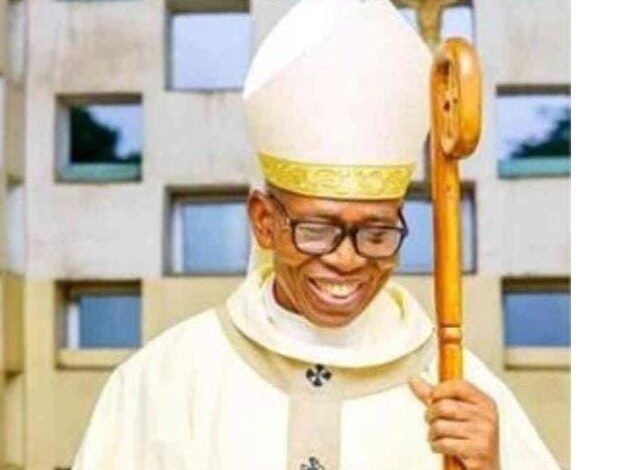
Were The Most Reverend Anthony John Valentine Obinna not a Catholic priest, his biological children and grandchildren would by today be celebrating what has become known in our native parlance as BIA RIE N’NDU (Come Let’s Celebrate While I Am Alive), which is usually put together to honour a parent, especially after hitting the octogenarian age bracket, and thank God Almighty for keeping him or she alive that long. Archbishop Emeritus Obinna has no children but since the beginning of this week, the media has been awash with notifications of a three-day programme to mark his 80th birthday anniversary, ranging from a novelty football match to a colloquium and, of course, a church service.
Attaining the age of 80 is a thing to be celebrated even for an ordinary folk but for an Archbishop Anthony Obinna, it would be impossible for his 80th anniversary on earth to not be a topic of immense interest. This is more so as the anniversary will be marked with so much nostalgia. Bishop Obinna – many didn’t quite get used to the additional sobriquet, “Arch” – dominated the religious, political, even social space in Imo state while he presided over the second oldest and second largest Archdiocese in the Southeast of Nigeria.
Apart from being the Bishop of the Owerri Catholic Archdiocese, Obinna was also the Metropolitan Archbishop of the Owerri Ecclesiastical Province, made up of Owerri Archdiocese, the Aba Diocese, Okigwe and Umuahia dioceses. The position was not attached to him personally – his successor, Lucius Ugorji, is now holding it – but Archbishop Obinna was highly influential in the entire province, even though as a rule, no Metropolitan Archbishop dictates to the Bishops of member dioceses.
In the entire Catholic community in Imo state – made up of Owerri Archdiocese, Orlu, Ahiara and Okigwe dioceses – Archbishop Obinna loomed large. For the almost three decades he was on seat as Archbishop (from March 1993 to March 2022), he was easily the most outspoken clergyman – even taking into account the other denominations – in this part of the country.
The nostalgia will, therefore, be a mixed one. On one hand, Bishop Obinna was outstanding in his pastoral work. He was a very caring shepherd. The clergy, the religious and even members of the laity referred to him as “Nna Anyi Ukwu” (Our Big Father); a rather worldly appellation but which appropriately described the reverence and love with which he was held. His presence was felt in every part of the Archdiocese. He personally presided over many activities at the parishes including burials, naming ceremonies and birthday anniversaries.
He was always there for individual and family members of the Archdiocese at their times of both grief and joy, all of which earned him the fond appellation, “The People’s Bishop” He was free with parishioners but he was also firm. In short, Bishop Obinna was described as a “very humble man”. From my personal assessment, Archbishop Obinna knew more than half of his parishioners by their first names. I once had a personal experience. Some years ago, he was in my home town, Umuowa, Ngor Okpala, to preside over the funeral mass of the mother of a native priest. After the service, I had the privilege of standing with him at the entrance of the church building while parishioners came to great him and to my amazement, he called each by his or her first name: Margaret! Desmond! Paulina! Ngozi! Innocent etc etc; even when as a native I do not know them by their names.
Although that friendly disposition endeared him to a majority of the members of the diocese, many complained about some of the policies he introduced. For instance, parishioners struggled to keep up with his policy of burying the dead within a period of two weeks. Many felt that the policy put families under undue pressure and ended up pushing the bereaved into borrowing; which would have been avoided had they been given time to put things together. Consequently, several families were unable to comply and had to put up with the consequence of not having the remains of their deceased loved ones taken to the church for a funeral mass, a highly valued practice among Catholics especially in Igboland.
I had a personal experience when my late mother died at the heat of the Covid-19 Pandemic in November 2020; a period which made compliance with his burial policy even more difficult. When my siblings and I were finally ready for the burial towards end-January 2021, that is after about two months, we went to the Archbishop to plead with him to preside over our mother’s funeral service.
He politely turned down our request, insisting that we had kept our mother beyond the period permitted by the church. He, however, agreed to send his second-in-command, Monsignor Kevin Akagha, who came to celebrate the funeral mass and conducted the burial proper. Obinna maintained that stance despite the fact that throughout the period our mother was sick, he visited our family home in Umuowa several times to pray for her; something he also did for several other families.
Now to the other aspect of the nostalgia. Archbishop Obinna was involved in politics. As a matter of fact, he was believed to be a card-carrying member of the All Progressives Grand Alliance (APGA).
This belief was fueled by events preceding the 2011 governorship election in Imo state, during which, as is well known, he openly campaigned for the party’s candidate, Rochas Okorocha. Although his opposition to Okorocha’s main opponent, Ikedi Ohakim, the then sitting governor, was largely hinged on the allegation – which turned out to be false – that the latter assaulted a Reverend Father, not a few believed that the Archbishop had long enlisted in the party before Okorocha grabbed its ticket, especially as a kinsman of his – Martin Agbaso – was its leader in the state. Details of the Archbishop’s involvement in the events surrounding the 2011 governorship election are too well known and outside the scope of this essay but it would be incomplete to write about him without making a mention of that saga, no matter how tangential.
Ahead of the 2011 governorship election, the Catholic Archdiocese of Owerri organized a debate for the governorship candidates at the premises of the Assumpta Cathedral, Owerri. Although some aides of Governor Ohakim, including this writer, were suspicious of the motives behind the debate, and had actually advised him not to attend – especially as there were feelers that two of his major opponents, Rochas Okorocha and Ifeanyi Araraume, both Catholics, were going to be there – the governor had a contrary view. He explained that a refusal to attend would fuel allegations of his disdain for the Catholic Church and would worsen his already deteriorated relationship with the leadership of the church.
Little did he know that the debate was meant to provide an avenue for the leadership of the church to get even with him. The Archbishop himself provided the lead. Once Governor Ohakim mounted the podium – the organizers craftily slated him to speak before both Araraume and Okorocha – he took notice of a woman picking empty sachets of “pure water” on the small green field at the center of the pavilion; whereupon the unsuspecting governor began to commend the woman for being “Clean And Green Complaint”. But promptly and unexpectedly came an interjection from the Archbishop: “Anyi Mega Nu Ya Emega Tupu Gi Abia” (We Were Doing It Before You Came). A section of the audience chorused something in apparent appreciation of what the cleric said. The governor, however, quickly regained his composure and proceeded to say that he was pleased to be in the midst of a gathering made up of mostly Catholics despite the fact that he was falsely accused of physically assaulting a Reverend Father. He could hardly complete his statement when the Archbishop again interjected: “Agala Ebe Ahu” (Don’t Go There) and promptly, the crowd, as if that was the moment it was waiting for, erupted. For more than fifteen minutes, the governor could not proceed with his speech on account of the cacophony that ensued. The Archbishop, perhaps surprised that things went that way, had to personally appeal to the crowd to keep calm. Although, the governor managed to complete his speech, it was not in doubt that he had just come out from an ambush.
Beginning from that moment, the leadership of the Catholic Church in Imo state went full throttle in its campaign against the re-election of Governor Ohakim; and the latter’s opponents took full advantage of that, to the extent that some of their members went to the Presidency, dressed as Catholic priests, to say that the entire Christians in the state were against the re-election of the governor.
The rest of the story is too well known to be repeated here but again, this essay would be incomplete without bringing in a particular incident that took place involving the Archbishop and Ohakim seven long years after.
On Tuesday February 13, 2018, the Catholic Archdiocese of Owerri, led by the Archbishop, gave an award to Ohakim which it tagged “Performance Award In Education And Reforms”. At the event, which took place at the Protea Hotel, Owerri, Archbishop Obinna said the award was in recognition of Ohakim’s policy of returning forty four missionary schools back to the church while the latter was governor. The Archbishop went on to say that Ohakim was the first governor in the Southeast to do such a thing and that that singular act reduced cultism and corruption in those schools. But perhaps the most significant feature of that event was that the Archbishop used the occasion to exonerate the former governor from the allegation of assaulting a Reverend Father. This was how he put it: “The award from the Catholic Archdiocese of Owerri also goes to put paid to the falsehood that Dr. Ikedi Ohakim assaulted a Reverend Father in 2010 while he was governor. It gladdens the heart therefore that this award puts paid to that malicious rumour.”
I can hear my critic ask why I have to return to the Reverend Father saga even after those at the center of the allegation later recanted. The answer is simple. Not many people are aware that Archbishop Obinna went that long to formally repudiate that allegation on his own behalf and that of the Catholic Church in the Archdiocese. Today, you would still hear some allude to the flogging of a Reverend Father without going the whole hog to tell the entire story; namely that apart from that Ohakim was exonerated, the Peoples Bishop, Nna Anyi Ukwu A.J.V Obinna by that act showed uncommon courage, humility and love.
Incidentally, it was in the same 2018 that the Archbishop got involved in another controversy that, quite ironically, had to do with officials and supporters of the administration of Rochas Okorocha whom had helped to power using the 2010 false allegation against Ohakim as an instrument. On Saturday March 3, 2018, Archbishop Obinna was presiding over a funeral service of Mrs Juliana Mbata, mother of Chief Alex Mbata, then the Pro-Chancellor of the Imo State University.
During his sermon, the Archbishop criticized the Imo state government and even urged the people to vote out the ruling All Progressives Congress (APC) in the coming general elections. Angered by that, some officials of the state government who accompanied the first lady, Mrs Nkechi Okorocha, who was present along with her son-in-law, Uche Nwosu, then a commissioner in the state and a governorship aspirant, invaded the altar and interrupted the Archbishop. One fellow even tried to take away the microphone from him.
Although there was not an outright physical assault on the Archbishop, the incident generated a big furore within and outside the state, with threats and counter threats between the Okorocha administration and the Catholic Archdiocese of Owerri. In what turned out to be the biggest irony in the political narrative of Imo state, the Okorocha administration issued a statement in which it noted that “we will not handle him with kid gloves as was done by the Ikedi Ohakim government”! The administration further went ahead to assert that the Archbishop “succeeded in his blackmail” under Ohakim but “that would not be the case this time”. In response, the Archdiocese fired back and accused the Okorocha administration of “declaring war against the Archbishop and the Catholic Church”. In the midst of the altercations, Archbishop Obinna personally issued a statement that brought the storm to an end, likening the incident to what happened to Jesus Christ on the cross.
Naturally, that episode sent many tongues wagging. While some believed that Okorocha’s political foes were having the last laugh – seeing him fighting with his former mentor – others saw it as again setting Obinna aside as a bold and courageous priest who was always out to speak truth to power.
The period under reference witnessed the biggest upheaval in the political history of the present day Imo state so far. Therefore, since the fellow we are celebrating today happened to have been at the center of those controversies that characterize the period, it would be an incomplete story to shy away from that aspect of the collective history of the good people of Imo state.
Outside his involvement in controversies around politics, Archbishop Obinna would be remembered as a social crusader. One of the things he fought very hard against was the Osu-Ume-Ohu caste practice in Igbo land. Although it is difficult to say whether or not the practice has actually been finally abolished in Igboland, there can be no doubt that his campaign achieved quite a lot. On Thursday March 22, 2022, just a few days before his retirement, Catholic Bishops in Igboland jointly issued a pastoral directive to end “the idolatrous, inhuman and painful discrimination among Ndigbo”