Ex-NADECO Chieftain Obioha Rejects Tinubu’s National Honour Over Insecurity, Kanu’s Detention

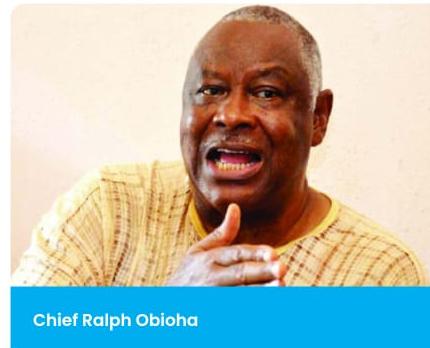
Former National Democratic Coalition (NADECO) activist and pro-democracy advocate, Chief Ralph Obioha, has declined the national honour recently conferred on him by President Bola Tinubu, citing the continued detention of IPOB leader Nnamdi Kanu and the worsening state of insecurity in Nigeria.
In a statement issued on Tuesday, Obioha expressed appreciation to President Tinubu and the Federal Government for the recognition but said accepting the award would be inconsistent with the democratic ideals that shaped his involvement in the struggle against military rule.
“I sincerely appreciate President Bola Ahmed Tinubu and the Federal Government of Nigeria for considering me worthy of a national honour during the 2026 Democracy Day celebrations,” he said.
“While I do not take this recognition lightly, I have, after careful reflection and in fidelity to the principles that guided our struggle under NADECO, decided to respectfully decline the award.”
Obioha recalled his role in the pro-democracy movement alongside several activists, including Tinubu, during the military era, stressing that their struggle was rooted in justice, freedom, the rule of law, and respect for fundamental human rights.
According to him, one of the core objectives of the June 12 struggle was the protection of freedom of expression, which he described as a vital pillar of any democratic society.
“Democracy thrives where citizens are free to express their views, including criticism of those in authority, without fear of persecution. Dissent is not a threat to democracy; it is one of its defining features,” he stated.
The former lawmaker said he found it difficult to accept the honour while Nnamdi Kanu remains in detention, arguing that the issue raises concerns about justice, due process, and the protection of fundamental freedoms.
“While opinions may differ regarding his methods or political objectives, the broader issue remains one of justice, due process, and constitutional rights,” he said.
Obioha added that President Tinubu, given his background in Nigeria’s democratic struggle, is uniquely positioned to pursue national reconciliation by addressing the Kanu matter in a way that promotes justice and national unity.
He also expressed concern over the country’s deteriorating security situation, lamenting the persistent cases of terrorism, banditry, kidnapping, and other violent crimes across the nation.
“Nigerians continue to lose their lives daily to insecurity. Families are displaced, communities devastated, and many citizens remain uncertain about their safety,” he said.
“The primary responsibility of government is the protection of life and property, and Nigerians expect stronger and more decisive action in addressing these challenges.”
Obioha emphasized that his decision should not be viewed as a personal attack on President Tinubu or a rejection of the national honours system, but rather as a principled stand based on the values that inspired the June 12 struggle.
“To accept this honour at a time when many of the values for which we fought remain insufficiently realised would, in my view, be inconsistent with my convictions. My conscience therefore compels me to respectfully decline the award,” he stated.
He reaffirmed his commitment to democracy, justice, national unity, freedom of expression, and the pursuit of a Nigeria where all citizens enjoy equal rights, dignity, security, and protection under the law.