STATE POLICE”: HOW THE TROUBLE BEGAN (1)Excerpt From NIGERIA: AGENDA FOR A MODERN POLICE FORCE (1991 A.N.A Award Winner).

“
By Ethelbert Okere


Nothing dominates national discourse in Nigeria today like insecurity.From banditry and kidnapping to insurgency and communal clashes, the crisis has taken an unprecedented dimension. In the search for lasting solutions, one proposal keeps resurfacing: decentralize policing. Move civil policing from its current exclusive federal control and allow states to establish, fund, and manage their own police forces — what we now call “State Police”.
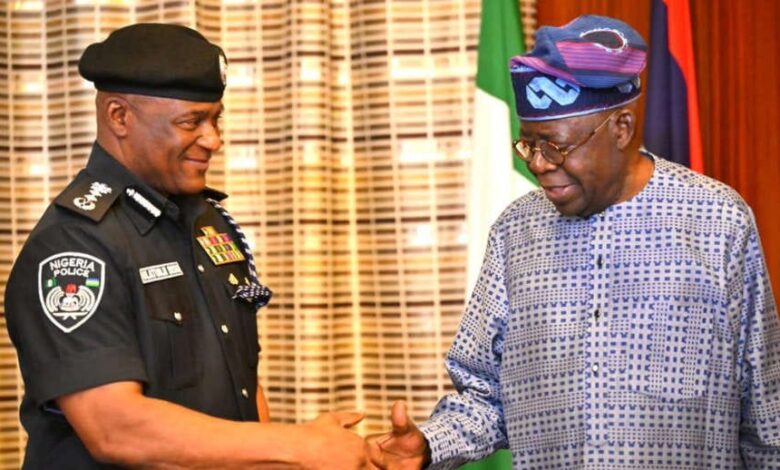
For years, Nigerians have debated the pros and cons without reaching consensus. But under President Bola Tinubu, the federal government has embraced the idea and is pushing it with unusual speed.
On President Tinubu’s directive, Inspector-General of Police Mr. Tunji Disu set up an eight-member steering committee in March 2026 to draft operational guidelines for state police. On June 16, 2026, the House of Representatives passed a constitutional amendment bill to create the legal room for it. The Senate is expected to follow. If both chambers pass it, the bill goes to the 36 state Houses of Assembly. With two-thirds approval — 24 out of 36 states — the 1999 Constitution will be amended and state police becomes law.
Still ,Nigerians remain divided. Supporters argue that local threats need local responses, and states understand their terrain better than Abuja. Critics fear “governor-capture” — that state governors will hijack the police to intimidate opponents and pursue partisan interests. Because of that fear, groups are urging lawmakers to “incorporate adequate safeguards in any enabling legislation to prevent abuse by state governments”.
The controversy is not new. The control of Nigeria’s police has been contested since the colonial era, and the arguments today are largely the same as those of decades past. As the debate resurfaces with renewed urgency, it pays to revisit how it before — and what lessons history offers.Even so, some equally well-meaning Nigerians also posit that what the country needs is not ” State Police” but total restructuring . I also interrogated this matter in my 2017 work, WE CAN’T ALL BE WRONG: NIGERIA AND THE RESTRUCTURING DEBATE. Earlier in 1991, I had examined the entire controversy in Chapter Twelve of my award-winning book, NIGERIA: AGENDA FOR A MODERN POLICE FORCE.. For context, I reproduce that chapter verbatim below.
Now, the excerpt:
“The issue of control of the Nigeria police force is as controversial as most other aspects of the force. Right from the pre-independence era, the question was a recurrent one but invariably remained unanswered. Even till today, the matter still remains somehow unresolved.
Once independence was in sight in the 1950s, there arose the demand for an indigenous control of the force. But the problem was not merely that of nationalization.
Disputes also arose between the federal and regional governments over control of the force. The constitutional arrangements at that time made the maintenance of law and order a concurrent responsibility between the federal and regional governments. This interest shown by the regional governments in the control of the force, also gave rise to different aspects of the controversy. The minority ethnic groups in the regions were apprehensive over a regionally controlled police. They thus openly expressed their preference for a federal police force.
That was not all. At that period also, the general public became increasingly dissatisfied with the weak police forces which existed in the Western and Northern regions. This also gave rise to a call for a re-appraisal of their control and their outright absorption into the federal force.
Despite these minor inter-regional differences, the nationalists actually focused their attention more on the issue of Nigerianization of the force. The crusade for Nigerianization was principally predicated on the very poor career prospects of Nigerian (then referred to as African Members) members of the force. The Nationalists at that time were so dissatisfied with the career prospects of Nigerians in the force that they actually began to query the qualifications of the expatriate members who were all above the Nigerians.
In 1955, a federal parliamentarian, Jaja Nwachukwu, was quoted as saying “…they-Europeans-are appointed from the outset as Assistant Superintendent of police, but Nigerians have myriads of ranks to pass through before they get to the rank of Assistant Superintendent of police”.
By 1960, some nationalists had began to go beyond mere Nigerianization, to insist on a Nigerian being appointed the head of the Nigerian Police force. Tamuno reports that, “In August 1960, K. Ezera (Bende East) was anxious to have any Nigerian then whether or not with police experience appointed to head the NPF on the grounds that only administrative ability was required for such a post”
However, the emerging national government refused to share in such sentiments since it considered it” .. a serious risk to entrust the headship of police institution where the highest professional standards were required before and after independence to a theoretically competent non-professional”. Thus, it was not until 1964 that the first indigenous head of the force was appointed.
The progress made with respect to Nigerianization di not, nonetheless, obliterate the controversy over control which, as mentioned earlier in the chapter, arose out of the appetite of the regional governments to exercise some control over the force, vis-à-vis the exclusivity of a federal control.
Those who were opposed to regionalization were particularly disturbed by the actions of some regional governments which tended to create room for the police coming under the control of the political parties. This was especially true of the them Local Government police in the western region, where by some members of the public, including some politicians, feared that the local police may become a secret police force in the region. In place of a regional control, they preferred the local police being put under the Inspector-General of the Nigerian Police force through the regional commissioner of police.
This idea was, however, rejected by the western regional government whose then Premier, Chief Obafemi Awolowo, was at that time said to be the most vociferous advocate of regional police. Tamuno writes:
“As the Premier of Western region, he considered it wrong in principle and humiliating in practice for a regional government vested with power and authority to maintain law and order to be without the means of discharging its responsibility. As a professional lawyer, he found no constitutional precedence in the federal constitutions of the British Commonwealth… to justify the centralization of the police proposed for Nigeria. Awolowo the politician considered it insulting for British Officials to think that only Nigerian Federal Ministers, not Nigeria regional ministers, could be trusted to use the police forces in the country responsibly. Awolowo the patriot, wanted the police services of the country regionalized so as to avert the possibility of a totalitarian regime in Nigeria”. The position of Awolowo and the entire Action group was amplified during a debate in the Western House of Assembly in June 1955 by Chief Anthony Enahoro, then Minister of Home Affairs in the region, when he said:
“we have no intention of subordinating our Local Government police force to the federal police… We think it is adequate that the Superintendent-General is subject to the control of the governor, and it will be too much to make the Superintendent-General subject not only to the Governor but also the Federal Police”
Apart from the Action Group, the politicians of the Northern People Congress (NPC), that was made up of the majority ethnic groups in the north were until 1958, pro-regionalization. However, both the National Council of Nigeria and the Camerouns (NCNC) and the Northern Elements Progressive Union (NEPU) wanted a unified federally-controlled force.
However, the 1958 Constitutional Conference approved that the Nigeria Police Force should be concentrated at the regions under the command of a Commissioner, but that the entire police in all the regions should be under the general control of the Inspector-General. The Conference also recommended the establishment of a Police Council to run the affairs of the force, the recommendation forming the origin of the Police Council whose composition has undergone a lot of changes, as every successive government since that date strives to continue to look into the ever-controversial issue of control.
The emergence of the Police Council more or less solved the problem of control since it implied that the Inspector-General was the indisputable head of the Nigeria Police Force. But the position of the local police – the Native Authority police force in the Northern region and the Local Government Police Force in the Western region – remained unsettled. This continued existence of two police forces – a federally controlled NPF and the regional police – was to the total discomfort of many Nigerians who saw the situation as most delicate for a newly independent nation. The fear was that the regional police force would be more vulnerable to manoeuvres by politicians than the federal force.
Thus, in spite of the assurance of a federally controlled Nigeria Police Force, the Nigerian public continued to call for an amalgamation of the regional forces and the NPF. Apart from the issue of political manoeuvers, the regional force were seen as less literate and inadequately trained to meet the needs of an “under-policed’ young nation. As depicted in Chief Awolowo’s statements above, the two regional governments claimed they needed the local forces to maintain law and order. But to the extent that no such force existed in the eastern region, critics of the regional police maintained that the latter were not absolutely necessary in the maintenance of law and order at the regional level. For these critics, therefore, the case of regionality could only be explained from point of view of selfish partisan ambition by the regional governments.
Yet, the federal government appeared not to be keen on the question of amalgamation of the two forces. Although the Federal Government was under no constitutional obligation to enforce a merger, many critics saw it as taking advantage of the opposition to merger by the western and northern regional governments to dodge the issue. For, according to them, the central government was cautious of the enormous cost of absorbing the two regional forces.
Apart from the financial considerations, the federal government found itself in a dilemma as far as the issue of amalgamation was concerned. In the event of it deciding to take over the regional forces, the process would have inevitably resulted in the retirement of some of the regional police personnel who were then seen as redundant. Yet, to the extent that Nigeria was seen to be then under-policed, such a move was perceived as capable of creating a serious security gap in the country.
While the cautious approach by the federal government persisted, the regions stood their grounds, refusing to yield to pressures for a merger. However, in 1964, the then newly created Mid-West region integrated the local force it inherited with the federal police in the region. The action was principally informed by the need for the new, poor region to avoid carrying the financial burden of a regional police force. In spite of this action by the Mid-West region, the eastern region, which had no local police, had by 1965 began to nurse the ambition of its own police force. But the change of heart seemed to have come too late; for the region never realized this dream before the military struck in January 1966.
Once the soldiers emerged in the political scene, the tone of the music chaned. The military discarded all excuses being brandished by politicians against amalgamation. Tamuno again writes “whereas the politicians had unsuccessfully tried to untie the Gordian knot of a wider police amalgamation, the post-coup military governments cut it with the sword”.
After the January 1966 coup, the military placed of both the Local Government police in the Western region and the Native Authority police of the Northern region under the Inspector-General.
The government set up a study which recommended a national police force and almost immediately, a gradual but steady integration of all police forces in the country began, with Alhaji Kam Selem, who succeded Louis Edet, as the new Inspector-general. There were not much changes in the machinery of control in the civil war years. Within the Federal Republic of Nigeria, all efforts and resources were concentrated on the prosecution of the civil war. Indeed, the war itself gave no room for any divisive tendencies. Of course, there were no politicians around to instigate or insinuate any.
In the Eastern region, a bulk of which had become the then Republic of Biafra, the police were almost rendered irrelevant with the menace of an ubiquitous Army and other categories of para-military organizations – the Militia, the Biafrian Organization of Freedom Fighters (BOFF) etc.
Thus, the Nigeria Police Force has since the advent of the military remained a national police force. But the problem of control again reared its ugly head in the Second Republic between October 1 1979 and December 31, 1983.
Again, like the pre-independence era and the First Republic, the issue was partisan, Chief Obafemi Awolowo again made it an election issue. Some state governments which were not controlled by the party that formed the federal government – the National Party of Nigeria (NPN) – felt that a federally controlled police was not for their interest. Although the call for state-controlled police forces was not as vehement as in the First Republic, the actions of some state govenors, nevertheless, precipitated a lot of confusion within the police. While there was rancor between the state governments and the police commands in some states, some police commands were accused to have become so pro-state governments that orders from Lagos suffered delays and were sometimes un-adhered to, notwithstanding the fact that police officers were employees of the federal government. In the states where the party that controlled the government was other than the NPN, the state government tended to over use the powers conferred on them by the 1979 constitution, “to give the Commissioner of Police of that state such lawful directives with respect to the maintenance and securing of public safety and public order within the state..”
However, by the provision of the same section of Constitution, the Commissioner of police of a state was not obliged to carry such directions until he gets clarification from the President or the Minister in charge of police matters. This provision which was supposed to be ordinarily unambiguous, however, gave room for certain partisan idiosyncrasies by persons of authority who complicated matters and made the job of many police officers quite cumbersome during that period..
To illustrate the relationship that existed between politicians and the police in the Second Republic, the following incident, perhaps already known, is narrated here. Chief Jim Nwobodo was the governor of Anambra State who was elected into office under the platform of the defunct Nigerian Peoples Party (NPP) . Mr. Bishop Eyitene was the then Commissioner of Police in charge of the state, and was first and foremost, a federal civil servant in a government controlled by the National Party of Nigeria (NPN). Anambra State, unlike other states, had a unique political setting at that period in the sense that whereas the state government was controlled by the NPP, Dr. Alex Ekwueme, an indigene of the state, was the Vice President of the Federal Republic of Nigeria controlled by the NPN.
Sometime in 1982, Ekwueme was to make a private visit to Oko, his home town. By official protocol and in spite of partisan differences, Nwobodo, the state governor, was supposed to receive the Vice President at the airport. But in spite of this arrangement, the governor was also scheduled to attend another ceremony at the Institute of Management and Technology (IMT), situated along Abakaliki road on the way to the airport.
Thus, when the Vice President arrived Enugu, the governor was not there to receive him. Eyitene and other top federal and state government functionaries, however, performed the protocol at the airport and shortly after, Ekwueme and his entourage left the airport on their way to Oko.
By the time the convoy left the airport, Nwobodo and his escort had also left Governor’s House on their way to IMT. Thus, at a point between Governor’s House and the Institute, the two convoys ran into one another, but the federal escort, being more fortified, conveniently brushed the Governor’s aside and passed on. Nwobodo later querried Eyitene on the incident which was said to have generated a lot of bad blood between the state government and the police in the state.
The incident was not, however, the first instance of misgivings between the two parties but it was the first open physical confrontation that formed the basis of further rancor as illustrated by another incident, also in Enugu.
In 1982, Archbishop Runcie of the Anglican Church was on an official visit to Nigeria, as a guest of the Federal government. As part of his programme, he was scheduled to visit Enugu.
At the airport on his arrival in Enugu, dignitaries, including Nwobodo, Eyitene and other Federal and State government functionaries, were there to receive him. But among the officials was an NPP party stalwart, a closed aide of Nwobodo, who was not official cleared by security agents to be among the officials to receive the Archbishop. Eyitene was said to have become worried and had asked the security agents to ask the party man to leave the scene. The latter was side to have refused to leave, whereupon the Commissioner of Police ordered that he be forcefully taken away.
After the incident at the airport, Nwobodo issued Eyitene a query demanding explanation as to why his aide was so badly treated. And the party man himself sued Eyitene and other security agents for assault. The mater was still pending in court when the second republic felt
However, the debate on the control of the police force, continued even after the second republic; and the desirability or otherwise of the re-introduction of regional police constituted the crux of such debates.
To Be Continued